
In modern businesses, efficient procurement and supply chain management are essential for smooth operations. Companies must ensure that raw materials, equipment, and services are available at the right time and at the right cost. To manage these processes efficiently, many organizations use enterprise resource planning (ERP) systems such as SAP.
One of the most important modules within the SAP ERP system is SAP Material Management (SAP MM). This module helps organizations manage procurement, vendor relationships, and inventory in an organized and automated way.
For students, graduates, and working professionals in Belagavi, understanding the end-to-end procurement process in SAP MM can be very valuable. Belagavi is home to several manufacturing and industrial companies that rely heavily on procurement and supply chain systems. Learning SAP MM can help individuals build careers not only in local industries but also in major IT and consulting companies across India.
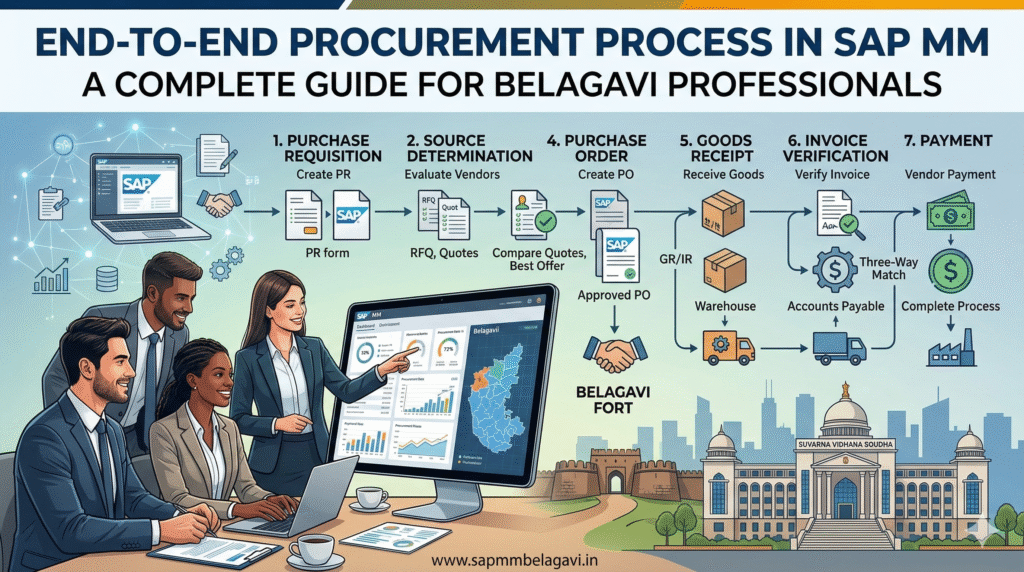
The procurement process in SAP MM follows a structured workflow known as the end-to-end procurement cycle. This cycle ensures that materials are requested, purchased, received, and paid for in a controlled and transparent manner. The major stages of this process include Purchase Requisition, Request for Quotation, Purchase Order, Goods Receipt, and Invoice Verification.
Purchase Requisition (PR)
The procurement process in SAP MM begins with a Purchase Requisition (PR). A purchase requisition is an internal document used by departments within a company to request the purchase of materials or services.
For example, a manufacturing company in Belagavi’s industrial area may require raw materials for production. In such a situation, the production department creates a purchase requisition in the SAP system to inform the procurement team about the requirement.
The purchase requisition contains important details such as:
- Material description
- Quantity required
- Delivery date
- Department requesting the materials
- Estimated cost or budget information
Once the purchase requisition is created, it usually goes through an approval process. Managers or department heads review the request to ensure it is necessary and aligned with the company’s budget.
After approval, the requisition is forwarded to the purchasing department. At this stage, no vendor is involved yet; the purchase requisition is simply an internal document that initiates the procurement process.
For professionals in Belagavi learning SAP MM, understanding how to create and manage purchase requisitions is one of the first practical skills required in procurement operations.
Request for Quotation (RFQ)
After the purchase requisition is approved, the purchasing department must find the best supplier for the required materials. This step involves creating a Request for Quotation (RFQ).
An RFQ is a document sent to multiple vendors asking them to provide price quotations for the materials or services required. The objective of this process is to identify the most suitable supplier based on price, quality, delivery time, and reliability.
In SAP MM, the RFQ contains detailed information such as:
- Material specifications
- Quantity required
- Delivery timeline
- Terms and conditions of purchase
Vendors respond with their quotations, which are then recorded in the SAP system. The procurement team can then compare the quotations using SAP’s quotation comparison tools.
For example, a manufacturing company in Belagavi may receive quotations from different suppliers across Karnataka or India. By comparing these quotations, the company can choose the vendor that offers the best value.
This process helps organizations maintain transparency and ensures that procurement decisions are made based on objective evaluation.
Purchase Order (PO)
Once the vendor is selected, the next step is to create a Purchase Order (PO). A purchase order is a formal document issued by the buyer to the supplier confirming the purchase.
The purchase order includes important information such as:
- Vendor name and details
- Description of materials
- Quantity and price
- Delivery location
- Delivery date
- Payment terms
In SAP MM, purchase orders can be created directly from approved purchase requisitions. This ensures that all procurement requests are properly documented and approved before orders are placed.
The purchase order is then sent to the selected vendor as an official confirmation of the purchase. Once the vendor accepts the purchase order, it becomes a legally binding agreement between the buyer and the supplier.
For industries in and around Belagavi’s manufacturing zones, purchase orders are essential for maintaining clear communication with suppliers and ensuring timely delivery of materials.
Goods Receipt (GR)
After the purchase order is issued and the vendor delivers the materials, the next step is Goods Receipt (GR).
Goods receipt is the process of confirming that the ordered materials have been received by the organization. When the goods arrive at the warehouse or storage facility, the receiving department checks the materials to ensure they match the purchase order in terms of quantity and quality.
In SAP MM, the goods receipt transaction records the arrival of materials in the system. Once the goods receipt is posted, the inventory levels are automatically updated.
This step is extremely important for companies because it ensures accurate stock records. For example, a manufacturing company in Belagavi can immediately see that the required raw materials are now available for production.
Another benefit of recording goods receipt in SAP is that it automatically generates accounting entries. This helps the finance department maintain accurate financial records related to procurement transactions.
Invoice Verification
The final stage of the procurement process is Invoice Verification. After delivering the materials, the vendor sends an invoice requesting payment.
The finance or accounts payable department receives the invoice and verifies it against the purchase order and goods receipt records. This process is known as three-way matching.
Three-way matching involves comparing three important documents:
- Purchase Order
- Goods Receipt
- Vendor Invoice
The purpose of this process is to ensure that the invoice amount matches the materials ordered and received. If the quantity, price, and details match correctly, the invoice is approved for payment.
In SAP MM, invoice verification is recorded in the system and automatically linked to the purchase order and goods receipt documents. Once approved, the payment process is handled by the finance department.
This final step completes the procurement cycle and ensures that suppliers are paid accurately and on time.
Importance of the SAP MM Procurement Process
The end-to-end procurement process in SAP MM helps organizations maintain transparency, efficiency, and control over purchasing activities. Each step in the process is documented within the SAP system, making it easier for companies to track transactions and monitor spending.
For companies in Belagavi’s industrial and manufacturing sectors, efficient procurement management is crucial. Materials must be purchased at the right time and cost to ensure uninterrupted production.
By using SAP MM, organizations can reduce manual errors, improve supplier management, and maintain accurate inventory records.
Career Opportunities for Belagavi Professionals
Understanding the SAP MM procurement cycle can create excellent career opportunities for students and professionals in Belagavi.
Many companies require trained professionals who can manage procurement operations using ERP systems. With proper training in SAP MM, individuals can work as:
- SAP MM End Users
- Procurement Executives
- SAP Support Consultants
- SAP Functional Consultants
- Supply Chain Analysts
While Belagavi has growing industrial opportunities, many SAP professionals also work in nearby technology hubs such as Bangalore, Pune, and Hyderabad, where ERP consulting jobs are widely available.
Conclusion
The end-to-end procurement process in SAP MM is a structured workflow that helps organizations manage purchasing and inventory operations efficiently. The process begins with a purchase requisition and continues through vendor selection, purchase order creation, goods receipt, and invoice verification.
Each stage of the procurement cycle plays an important role in ensuring that materials are purchased, delivered, and paid for accurately.
For students and professionals in Belagavi, learning SAP MM and understanding this procurement process can provide a strong foundation for a career in supply chain management, procurement operations, and ERP consulting. With the growing demand for SAP professionals across industries, mastering SAP MM can open the door to rewarding career opportunities in India and beyond.