
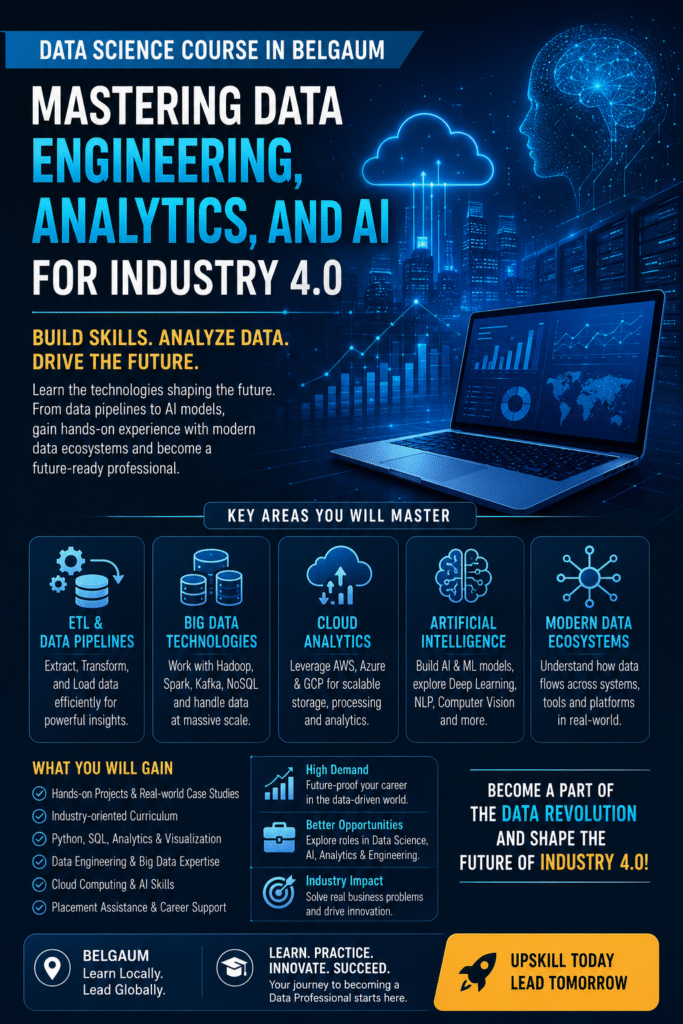
The rapid advancement of technology is transforming industries across the globe. From manufacturing and healthcare to banking and retail, organizations are generating massive volumes of data every day. This data has become one of the most valuable business assets, driving innovation, decision-making, and competitive advantage. As Industry 4.0 continues to reshape the business landscape, the demand for skilled professionals in Data Science, Data Engineering, Analytics, and Artificial Intelligence (AI) is growing at an unprecedented rate.
For students and working professionals in Belgaum, enrolling in a Data Science course can open doors to exciting career opportunities in the digital economy. A comprehensive Data Science program equips learners with the technical and analytical skills needed to work with modern data ecosystems, including ETL processes, Big Data technologies, Cloud Analytics, Machine Learning, and AI-powered solutions.
Understanding Industry 4.0 and the Role of Data Science
Industry 4.0 refers to the fourth industrial revolution, characterized by the integration of digital technologies, automation, cloud computing, the Internet of Things (IoT), Artificial Intelligence, and advanced analytics into business operations. Organizations are increasingly relying on data-driven strategies to optimize processes, improve customer experiences, and increase profitability.
Data Science serves as the foundation of Industry 4.0 by transforming raw data into meaningful insights. Through statistical analysis, predictive modeling, and machine learning, businesses can uncover patterns, forecast trends, and make informed decisions faster than ever before.
A modern Data Science course in Belgaum helps students understand how data flows through an organization and how it can be leveraged to solve real-world business challenges.
Data Engineering: Building the Foundation of Data-Driven Organizations
Before organizations can analyze data, they need a reliable infrastructure to collect, process, and store it. This is where Data Engineering plays a critical role.
Data Engineers design and manage systems that handle large-scale data processing. They ensure that data from multiple sources is collected, cleaned, transformed, and made available for analytics and AI applications.
Key Data Engineering concepts covered in a Data Science course include:
- Data Pipelines
- Database Management
- Data Warehousing
- Data Lakes
- Cloud Storage Solutions
- Real-Time Data Processing
- Distributed Computing
Data Engineering is considered one of the highest-paying fields within the data industry because businesses depend on efficient data infrastructure for successful analytics initiatives.
ETL: The Backbone of Data Management
One of the most important components of Data Engineering is ETL, which stands for Extract, Transform, and Load.
Extract
Data is gathered from various sources such as websites, applications, databases, IoT devices, and business systems.
Transform
The collected data is cleaned, standardized, and organized into a consistent format. This step removes errors, duplicates, and inconsistencies.
Load
The transformed data is loaded into a data warehouse or cloud platform where it becomes available for analysis and reporting.
ETL processes enable organizations to maintain high-quality data and ensure accurate decision-making. Modern Data Science courses provide practical training in ETL tools and workflows, helping students understand how enterprises manage data at scale.
Big Data Technologies: Managing Massive Volumes of Information
Traditional databases often struggle to handle the enormous amount of data generated by modern businesses. Big Data technologies have emerged to address this challenge.
Big Data refers to datasets that are too large, complex, or fast-moving for conventional systems to process efficiently.
The five key characteristics of Big Data are:
- Volume – Large amounts of data
- Velocity – High-speed data generation
- Variety – Different data formats
- Veracity – Data accuracy and reliability
- Value – Business insights derived from data
A Data Science course typically introduces students to Big Data tools such as:
- Hadoop
- Apache Spark
- Hive
- Kafka
- NoSQL Databases
- Distributed Storage Systems
These technologies enable organizations to process millions of transactions, customer interactions, and sensor readings in real time.
Industries such as e-commerce, finance, healthcare, telecommunications, and manufacturing heavily rely on Big Data analytics to gain competitive advantages.
Cloud Analytics: The Future of Data Infrastructure
Cloud computing has revolutionized the way organizations manage and analyze data. Instead of maintaining expensive on-premise servers, businesses can leverage cloud platforms for scalability, flexibility, and cost efficiency.
Cloud Analytics combines cloud computing with advanced data analysis capabilities, allowing organizations to process large datasets quickly and securely.
Popular cloud platforms include:
- Amazon Web Services (AWS)
- Microsoft Azure
- Google Cloud Platform (GCP)
A modern Data Science course in Belgaum often includes cloud-based learning modules where students gain hands-on experience with:
- Cloud Storage
- Data Warehousing
- Cloud Databases
- Data Visualization Services
- Machine Learning Platforms
- Serverless Computing
Cloud Analytics enables businesses to access real-time insights, improve collaboration, and accelerate innovation while reducing infrastructure costs.
Artificial Intelligence: Transforming Industries Through Intelligent Systems
Artificial Intelligence is one of the most exciting and transformative technologies of the Industry 4.0 era. AI allows machines to simulate human intelligence and perform tasks that traditionally required human intervention.
AI applications include:
- Recommendation Systems
- Chatbots and Virtual Assistants
- Fraud Detection
- Predictive Maintenance
- Medical Diagnosis
- Autonomous Vehicles
- Customer Behavior Analysis
Data Science courses teach the fundamentals of AI, including:
- Machine Learning
- Deep Learning
- Natural Language Processing (NLP)
- Computer Vision
- Neural Networks
- Predictive Analytics
By learning AI techniques, students can develop intelligent systems capable of solving complex business problems and generating valuable insights from data.
Modern Data Ecosystems: Connecting Everything Together
Today’s organizations operate within interconnected data ecosystems where data flows continuously across applications, devices, cloud platforms, and analytics tools.
A modern data ecosystem consists of:
- Data Sources
- ETL Pipelines
- Data Warehouses
- Data Lakes
- Analytics Platforms
- AI Models
- Business Intelligence Dashboards
Understanding how these components work together is essential for anyone pursuing a career in Data Science.
A comprehensive Data Science course provides practical exposure to the complete data lifecycle, enabling students to build end-to-end solutions that support business decision-making.
Career Opportunities After a Data Science Course
The demand for data professionals continues to rise globally. Companies across various industries are actively seeking individuals with expertise in analytics, data engineering, and AI.
Popular career paths include:
- Data Analyst
- Business Analyst
- Data Scientist
- Data Engineer
- Machine Learning Engineer
- AI Engineer
- Cloud Data Engineer
- Business Intelligence Developer
- Analytics Consultant
Professionals with strong Data Science skills often enjoy excellent salary packages, career growth opportunities, and the flexibility to work across multiple industries.
Why Choose a Data Science Course in Belgaum?
Belgaum is rapidly emerging as an educational and technology-focused city, offering opportunities for students and professionals to develop industry-relevant skills. A quality Data Science course provides:
- Hands-on Projects
- Industry-Oriented Curriculum
- Python Programming Training
- SQL and Database Skills
- Machine Learning Fundamentals
- Big Data Technologies
- Cloud Analytics Experience
- Placement Assistance
- Real-World Case Studies
These skills prepare learners to meet the growing demands of Industry 4.0 and contribute to data-driven business transformation.