
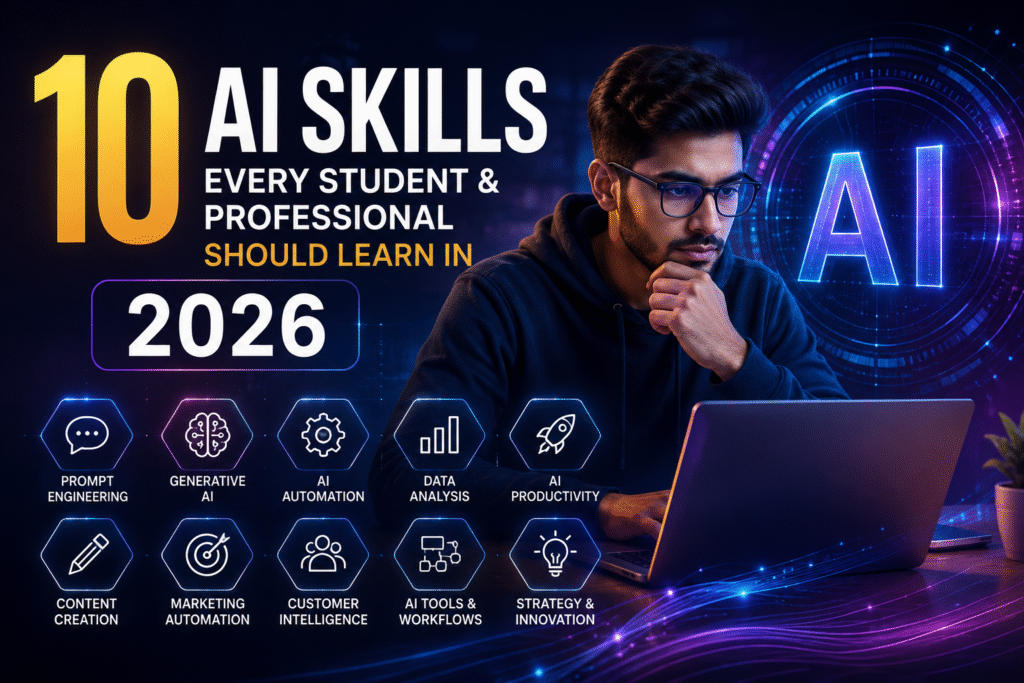
For students and working professionals in Belgaum, learning practical AI skills can be an excellent way to prepare for the changing job market. AI is not only for programmers or technology professionals. Today, people from different educational and
Artificial Intelligence (AI) is rapidly becoming one of the most important technologies in the modern workplace. From marketing and business to finance, education, technology, healthcare, and customer service, organizations are increasingly using AI to improve productivity and make better decisions.
For students and working professionals in Belgaum, learning practical AI skills can be an excellent way to prepare for the changing job market. AI is not only for programmers or technology professionals. Today, people from different educational and professional backgrounds can use AI tools to work faster, create better content, analyze information, automate repetitive tasks, and improve their career opportunities.
Whether you are a student looking for your first job, a working professional wanting to upgrade your skills, or someone planning a career change, here are 10 AI skills you should consider learning in 2026.
1. Prompt Engineering
One of the most useful AI skills is the ability to write effective prompts.
A prompt is the instruction given to an AI system to generate a response or perform a task. Good prompts can help AI produce more relevant, structured, and useful results.
Students and professionals can use prompt engineering for:
- Research and brainstorming
- Content creation
- Report preparation
- Marketing ideas
- Data interpretation
- Learning new subjects
- Business planning
- Productivity
Learning how to give AI clear context, objectives, constraints, examples, and desired output formats can significantly improve the quality of results.
2. Generative AI
Generative AI can create or transform different types of content, including text, images, presentations, audio, and video.
Students can use generative AI as a learning and productivity assistant, while professionals can use it for business and creative tasks.
For example, a digital marketing professional can use AI to develop campaign ideas, social media concepts, blog outlines, email drafts, and advertising variations.
Understanding the capabilities and limitations of generative AI is becoming an important workplace skill.
3. AI-Powered Content Creation
Content is essential for modern businesses. Websites, blogs, social media platforms, advertisements, newsletters, and videos all require regular content.
AI can assist with:
- Blog research
- Content ideas
- Social media captions
- Video scripts
- Email drafts
- Advertising copy
- Content repurposing
However, successful content creation still requires human creativity, editing, fact-checking, brand understanding, and audience knowledge.
Professionals who combine AI with strong communication skills can potentially create content more efficiently.
4. AI Automation
AI automation is another valuable skill for students and professionals.
Many businesses spend significant time on repetitive activities such as organizing information, sending routine messages, generating reports, managing leads, and updating records.
AI and automation tools can help connect different applications and create workflows that reduce manual work.
Understanding basic automation can be particularly useful for business owners, marketers, administrative professionals, freelancers, and entrepreneurs.
For example, a business could create an automated workflow that captures a lead, organizes customer information, sends a follow-up message, and notifies the sales team.
5. AI-Powered Data Analysis
Data is everywhere, but raw data is not useful unless people can understand it.
AI can assist professionals in analyzing spreadsheets, identifying patterns, summarizing information, generating insights, and asking questions about datasets.
Learning basic data analysis along with AI can help professionals make more informed decisions.
Students can also develop these skills through practical projects involving sales data, marketing campaigns, customer information, or business reports.
You don’t necessarily need to become a data scientist. Understanding how to interpret data and use AI to support analysis can already be valuable.
6. AI for Digital Marketing
Digital marketing is one area where AI is having a major impact.
AI tools can support marketers with:
- SEO research
- Content planning
- Social media management
- Advertising copy
- Customer research
- Audience segmentation
- Campaign analysis
- Marketing automation
For students interested in digital marketing jobs, combining traditional marketing knowledge with AI skills can provide a useful competitive advantage.
Professionals can learn how AI can support Google Ads, social media campaigns, SEO, email marketing, content marketing, and lead generation.
7. AI Productivity
AI can become a personal productivity assistant when used correctly.
Professionals can use AI to summarize information, organize ideas, draft documents, prepare meeting notes, create task lists, brainstorm solutions, and learn new concepts.
Students can use AI to organize study materials, understand difficult concepts, prepare questions, and improve their learning process.
The goal is not to let AI do everything. Instead, the goal is to use AI to reduce repetitive work and spend more time on important thinking and decision-making.
8. AI Research and Information Analysis
The ability to research effectively is becoming increasingly important.
AI can help users summarize large amounts of information, compare ideas, identify important themes, and organize research.
However, users should learn to verify important information rather than accepting every AI-generated answer as fact.
Developing strong research habits combined with AI tools can help students and professionals work more efficiently while maintaining accuracy.
9. AI-Assisted Customer Targeting
Understanding customers is at the heart of successful marketing and business.
AI can help businesses identify customer patterns, segment audiences, personalize communication, and understand customer behaviour.
For digital marketers, these skills can be useful when creating campaigns for different customer groups.
For example, instead of communicating with every customer in exactly the same way, businesses can develop different messages based on customer interests, behaviour, location, or stage in the buying journey.
Learning customer research and AI-assisted personalization can therefore be valuable for modern marketing professionals.
10. AI Strategy and Problem Solving
The most valuable AI skill may not be using a specific tool. It is knowing how to identify problems that AI can help solve.
A professional who understands business objectives can look at a repetitive process and ask:
- Can this task be automated?
- Can AI reduce the time required?
- Can customer data provide better insights?
- Can content production be improved?
- Can AI help the team make better decisions?
This strategic approach can make AI much more useful than simply knowing how to use individual tools.
How AI Skills Can Help With Digital Marketing Jobs
The growth of AI is changing the skills expected from digital marketing professionals.
People applying for digital marketing jobs may increasingly benefit from knowing how to use AI for content, SEO, social media, advertising, analytics, automation, and customer research.
Potential career paths include:
- Digital Marketing Executive
- SEO Executive
- Social Media Specialist
- Performance Marketing Executive
- Content Marketing Specialist
- Digital Marketing Analyst
- Marketing Automation Specialist
- AI-Assisted Marketing Specialist
- Digital Marketing Consultant
The combination of marketing knowledge, creativity, analytical thinking, and AI skills can help professionals adapt as the industry evolves.
Why Learn AI Skills in Belgaum?
For students and professionals in Belgaum, developing AI skills can help create opportunities across local businesses as well as remote and broader job markets.
Businesses increasingly need people who understand digital tools, online marketing, automation, content creation, data, and customer engagement.
A practical AI or digital marketing program can help learners move beyond theory by working on real-world projects and developing a portfolio that demonstrates their abilities.
Students should look for training that focuses on practical application rather than simply collecting certificates.
What Should You Learn First?
If you are completely new to AI, don’t try to learn everything at once.
A practical learning path could be:
Step 1: Learn AI fundamentals.
Step 2: Develop prompt engineering skills.
Step 3: Practice with generative AI.
Step 4: Learn AI productivity tools.
Step 5: Explore data analysis and automation.
Step 6: Apply AI to your chosen career field.
For students interested in marketing, this could mean combining AI with SEO, social media, advertising, analytics, and content marketing.
Conclusion
AI is becoming a valuable workplace skill, but learning AI is not simply about knowing how to use the latest tool.
The real advantage comes from understanding how to use AI to solve real problems.
For students and working professionals in Belgaum, developing skills such as prompt engineering, generative AI, automation, data analysis, AI productivity, and AI-powered digital marketing can help prepare for an evolving job market.
If your goal is to build a career in digital marketing jobs, freelancing, business, or another professional field, start by learning the fundamentals and then apply AI to practical projects.
The professionals who succeed in the AI-powered workplace will not necessarily be those who know the most AI tools. They will be the people who how to think, create, analyze, adapt, and use AI effectively.