
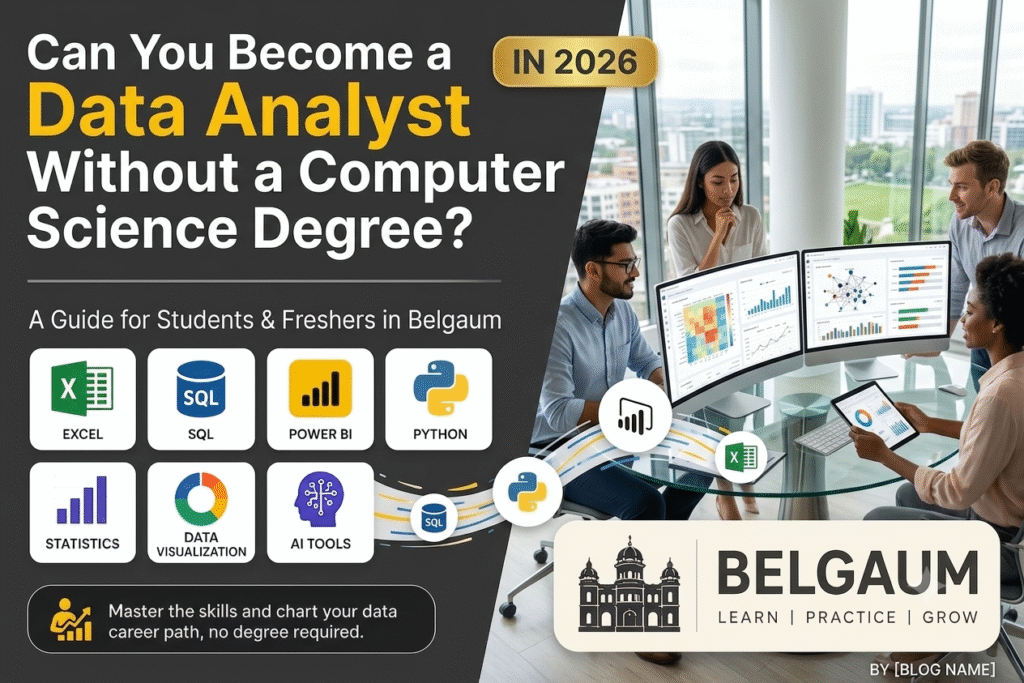
Are you interested in building a career in data analytics but worried because you do not have a Computer Science degree? You are not alone.
Many students and freshers believe that becoming a data analyst requires a degree in Computer Science, Information Technology, or Engineering. While a technical degree can be useful, it is not the only path into the field. What matters more is developing the right skills, gaining practical experience, understanding business problems, and demonstrating what you can do.
For students and freshers in Belgaum, data analytics can be an exciting career option if you are willing to learn and practice consistently. With skills such as Excel, SQL, Power BI, Python, statistics, data visualization, and modern AI tools, you can build a strong foundation for entry-level data analytics jobs.
This guide explains how you can start your journey even without a Computer Science background.
What Does a Data Analyst Do?
Before choosing a career, it is important to understand what a data analyst actually does.
A data analyst works with data to help businesses make better decisions. Companies collect information about customers, sales, marketing campaigns, employees, finances, inventory, and operations. However, raw data by itself does not provide useful answers.
A data analyst turns that raw information into meaningful insights.
For example, a retail business may want to know:
- Which products are selling the most?
- Which location has the highest sales?
- Which customers generate the most revenue?
- Why did sales decrease last month?
- Which marketing campaign generated the best results?
The analyst collects and cleans the relevant data, performs analysis, creates reports or dashboards, and communicates the findings to decision-makers.
This means data analytics is not only about coding. It is also about problem-solving, logical thinking, communication, and understanding business requirements.
Do You Need a Computer Science Degree?
The short answer is no, not necessarily.
A Computer Science degree can provide useful technical knowledge, but data analytics is a broad field that attracts people from many educational backgrounds.
Students and graduates from fields such as:
- BCom
- BBA
- BCA
- BA
- BSc
- Engineering
- Finance
- Economics
- Mathematics
- Marketing
can develop data analytics skills.
Your educational background may influence which industries or roles you target, but your practical skills can play an important role when applying for entry-level positions.
Instead of focusing only on your degree, focus on answering an employer’s most important question:
Can you work with data and solve business problems?
Skills You Need to Become a Data Analyst
If you are a fresher without a Computer Science degree, developing practical skills should be your priority.
1. Excel
Excel is an excellent starting point for beginners.
Learn formulas, functions, Pivot Tables, data cleaning, charts, conditional formatting, and dashboard creation.
Excel is still widely used by businesses for reporting and analysis, making it a valuable skill for entry-level data analytics jobs.
2. SQL
SQL is one of the most important technical skills for data analysts.
Businesses store huge amounts of information in databases, and SQL allows analysts to retrieve and analyze that information.
Start by learning:
- SELECT
- WHERE
- ORDER BY
- GROUP BY
- JOIN
- CASE statements
- Subqueries
- Common Table Expressions
- Window functions
You can practice SQL using sample sales, customer, employee, and e-commerce databases.
3. Power BI
Power BI helps you convert data into interactive dashboards.
You can use it to create reports for sales, finance, marketing, operations, and customer analytics.
Learning Power BI can also help you demonstrate your abilities during interviews because you can show employers actual dashboards instead of simply listing the software on your resume.
4. Python
Python is useful for data cleaning, automation, visualization, and advanced analysis.
You do not need to become an expert programmer immediately.
Start with Python fundamentals and gradually learn libraries such as Pandas, NumPy, and Matplotlib.
Once you understand the basics, you can use Python to automate repetitive analytical tasks and work with larger datasets.
5. Statistics
Statistics helps you understand whether the conclusions you make from data are reliable.
Start with concepts such as:
- Mean
- Median
- Mode
- Probability
- Percentage
- Standard deviation
- Correlation
- Sampling
- Hypothesis testing
- Basic regression
A good data analyst should understand the meaning behind numbers rather than simply generating calculations.
How AI Is Changing Data Analytics
Artificial intelligence is becoming an increasingly important part of the modern data analytics workflow.
AI tools can assist beginners and experienced analysts with tasks such as:
- Creating Excel formulas
- Explaining SQL queries
- Generating Python code
- Summarizing data
- Suggesting data-cleaning techniques
- Finding possible trends
- Creating report summaries
- Brainstorming dashboard ideas
For example, if you are learning SQL and do not understand why a query is returning an error, an AI tool can help explain the problem.
However, AI should be treated as a productivity assistant, not as a substitute for learning.
You still need to understand the fundamentals, check AI-generated answers, validate calculations, protect confidential information, and make sound analytical decisions.
This makes data analytics and AI an increasingly useful combination for people entering the job market.
Build Projects Instead of Depending Only on Certificates
One of the most important things you can do as a fresher is build a portfolio.
A certificate can show that you completed a course, but a project can demonstrate how you actually apply your knowledge.
Consider building projects such as:
Sales Analytics Project
Analyze sales data to identify the best-performing products, monthly revenue trends, and regional performance.
Customer Analytics Project
Analyze customer purchases and identify high-value customer segments.
Marketing Analytics Project
Analyze campaign data to compare clicks, conversions, spending, and campaign performance.
Finance Analytics Dashboard
Build a Power BI dashboard showing income, expenses, profit, and financial trends.
E-Commerce Analytics Project
Analyze online orders to identify popular products, customer behavior, order values, and sales patterns.
For each project, explain the problem you were trying to solve, how you cleaned the data, which tools you used, what you discovered, and what recommendations you would give the business.
Create a Job-Ready Portfolio
Your portfolio should demonstrate several skills together.
For example, you could create one project where you:
Use Excel to initially clean the data.
Use SQL to query and organize the database.
Use Python for additional data cleaning or analysis.
Use Power BI to create an interactive dashboard.
Use statistics to interpret the results.
Use AI tools to assist with repetitive tasks or improve your workflow.
This type of project shows employers that you understand how different data analytics tools work together.
What Data Analytics Jobs Can You Apply For?
Once you develop the required skills, you can explore different entry-level career options.
Potential roles include:
- Data Analyst
- Junior Data Analyst
- Business Analyst
- Reporting Analyst
- MIS Analyst
- Marketing Analyst
- Operations Analyst
- Business Intelligence Analyst
- Financial Data Analyst
The exact requirements will vary from one employer to another. Some positions may prioritize SQL, while others may focus more heavily on Excel, Power BI, business knowledge, or statistics.
Therefore, read job descriptions carefully and identify the skills that companies are requesting.
Data Analytics Opportunities in Belgaum
For students and freshers in Belgaum, learning data analytics can provide opportunities across different sectors.
Businesses in areas such as manufacturing, retail, healthcare, education, finance, marketing, and technology can benefit from professionals who know how to analyze business information.
You should also avoid limiting your career search to only companies physically located in Belgaum. Depending on the role and employer, remote and hybrid opportunities may also be available.
Building a strong portfolio allows you to demonstrate your skills to employers regardless of where they are located.
A Simple Roadmap for Beginners
If you are starting from zero, follow a structured approach.
Step 1: Learn Excel and basic statistics.
Step 2: Learn SQL and practice database queries.
Step 3: Learn Power BI and create dashboards.
Step 4: Learn Python for data analytics.
Step 5: Explore AI tools and understand responsible AI-assisted analytics.
Step 6: Build three to five practical projects.
Step 7: Create a professional resume and portfolio.
Step 8: Practice data analytics interview questions.
Step 9: Apply consistently for suitable entry-level jobs.
The most important part is consistency. Spending a few hours every week practicing real datasets can be more valuable than simply watching tutorials without applying what you learn.
Final Thoughts
So, can you become a data analyst without a Computer Science degree?
Yes, you can build the skills needed to pursue a data analytics career even if your academic background is different.
Your degree is only one part of your professional profile. Practical skills, projects, analytical thinking, communication, and your ability to solve real business problems can help you stand out.
If you are a student or fresher in Belgaum, start with the fundamentals: Excel, SQL, Power BI, Python, statistics, and data visualization. Then add AI tools to your skill set and learn how they can improve your productivity.
Most importantly, do not wait until you feel completely ready before building projects. Start with small datasets, solve simple problems, create dashboards, and gradually take on more challenging projects.
For students looking for data analytics courses in Belgaum, choose a learning program that provides practical training, real-world projects, AI exposure, portfolio development, and interview preparation.
A Computer Science degree can be helpful, but your willingness to learn, practice, and demonstrate your skills can be just as important when starting your journey toward data analytics jobs.