
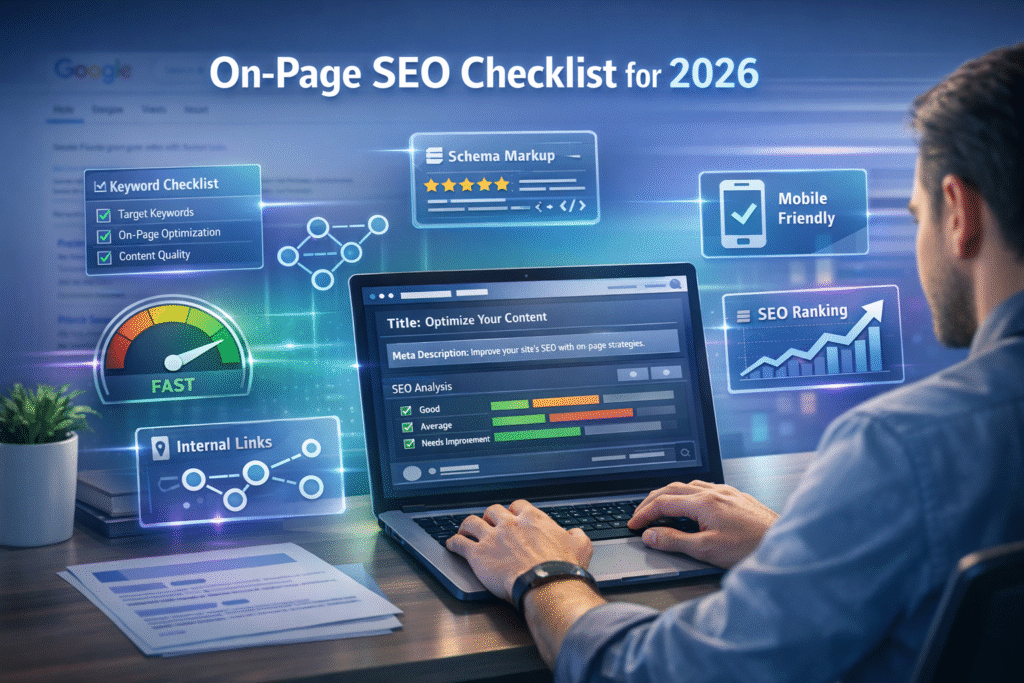
Search engine optimization continues to evolve every year. With smarter algorithms, AI-driven search results, and user-focused ranking systems, on-page SEO in 2026 is no longer just about keywords — it’s about experience, structure, and intent.
If you want to rank on search engines like Google Search, this complete On-Page SEO checklist will help you optimize your website effectively.
What Is On-Page SEO?
On-page SEO refers to all the optimizations you make directly on your website pages to improve rankings and user experience.
It includes:
- Content optimization
- Title tags and meta descriptions
- URL structure
- Internal linking
- Technical elements
- User experience improvements
Unlike off-page SEO (like backlinks), on-page SEO is fully under your control.
Complete On-Page SEO Checklist for 2026
1. Optimize Your Page Title (Title Tag)
Your title tag is one of the strongest ranking factors.
✅ Keep it under 60 characters
✅ Include your primary keyword naturally
✅ Make it compelling for higher CTR
✅ Avoid keyword stuffing
Example:
Instead of: SEO Tips
Use: On-Page SEO Checklist for 2026 – Complete Guide
2. Write a High-Converting Meta Description
Meta descriptions don’t directly impact rankings, but they influence click-through rate.
✅ Keep it under 155–160 characters
✅ Include main keyword
✅ Add a benefit or hook
✅ Use action words
Think of it as your ad copy in search results.
3. Use Proper Heading Structure (H1, H2, H3)
Search engines use headings to understand content structure.
Best practice:
- Only one H1 per page
- Use H2 for main sections
- Use H3 for sub-sections
- Include keywords naturally
A clear hierarchy improves both readability and SEO.
4. Optimize URL Structure
Clean URLs perform better.
✅ Short and descriptive
✅ Include primary keyword
✅ Avoid unnecessary numbers or symbols
Good example:
yourwebsite.com/on-page-seo-checklist-2026
Bad example:
yourwebsite.com/page?id=12345
5. Focus on Search Intent
In 2026, search intent matters more than keyword density.
Ask yourself:
- Is the user looking for information?
- Are they ready to buy?
- Do they want a comparison?
Match your content format to intent:
- Informational → Blog guide
- Transactional → Product page
- Comparison → Review article
6. Optimize Content Quality
Google’s algorithm prioritizes helpful, people-first content.
Your content should be:
✅ In-depth
✅ Accurate
✅ Well-structured
✅ Easy to read
✅ Updated regularly
Add:
- Examples
- Data points
- FAQs
- Bullet points
- Clear formatting
Avoid thin or AI-generated content without human editing.
7. Keyword Optimization (Smart Usage)
In 2026, semantic SEO is key.
Instead of repeating the same keyword, use:
- Related terms
- Synonyms
- Contextual phrases
- Question-based queries
Use your primary keyword in:
- Title
- First 100 words
- One subheading
- Meta description
- URL
But keep it natural.
8. Optimize Images Properly
Images improve user engagement but must be optimized.
Checklist:
✅ Compress images for faster loading
✅ Use descriptive file names
✅ Add keyword-rich alt text
✅ Use modern formats (WebP where possible)
Image SEO helps in both search and accessibility.
9. Improve Page Speed
Page speed is a ranking factor.
Use tools like Google PageSpeed Insights to analyze performance.
Improve speed by:
- Compressing images
- Minimizing CSS/JS
- Using caching
- Choosing reliable hosting
Fast websites rank better and convert more.
10. Make Your Site Mobile-Friendly
Mobile-first indexing is standard in 2026.
Your website must:
✅ Be responsive
✅ Load quickly on mobile
✅ Have readable font sizes
✅ Avoid intrusive popups
Test using Google Search Console mobile usability reports.
11. Internal Linking Strategy
Internal links help:
- Distribute authority
- Improve crawlability
- Increase time on site
- Guide users through content
Best practices:
✅ Link to relevant pages
✅ Use descriptive anchor text
✅ Avoid over-linking
12. Add Structured Data (Schema Markup)
Schema markup helps search engines understand your content better.
Use structured data for:
- FAQs
- Reviews
- Products
- Articles
This can increase your chances of appearing in rich results.
13. Optimize for Featured Snippets
To increase visibility:
- Answer questions clearly
- Use bullet points
- Add numbered lists
- Keep answers concise (40–60 words for snippet targets)
Structure content to directly answer common queries.
14. Improve User Experience (UX Signals)
Search engines analyze:
- Bounce rate
- Time on page
- Click behavior
Improve UX by:
- Clear layout
- Readable fonts
- Good spacing
- Clear CTAs
- Minimal clutter
User satisfaction directly influences rankings.
15. Keep Content Fresh
Update older blog posts with:
- New statistics
- Updated screenshots
- New sections
- Recent examples
Freshness signals matter in competitive niches.
Quick On-Page SEO Summary Checklist
Before publishing, confirm:
- ✔ Optimized title
- ✔ Compelling meta description
- ✔ Clean URL
- ✔ Proper heading structure
- ✔ High-quality content
- ✔ Internal links added
- ✔ Images optimized
- ✔ Page speed tested
- ✔ Mobile-friendly
- ✔ Schema implemented
Final Thoughts
On-page SEO in 2026 is about more than keywords. It’s about delivering value, optimizing structure, and creating a seamless user experience.
If you consistently apply this On-Page SEO checklist, your website will be better positioned to rank on Google Search and attract high-quality organic traffic.
SEO is no longer just technical — it’s strategic, user-focused, and experience-driven.