
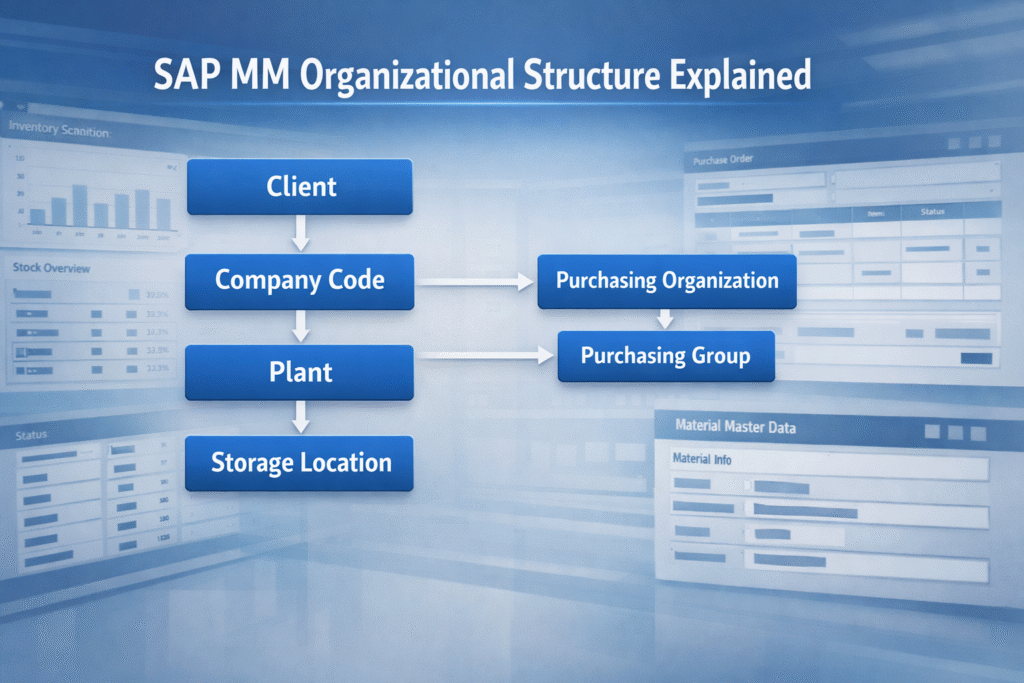
SAP MM Organizational Structure Explained
Understanding the organizational structure in SAP MM is essential for anyone working in procurement, inventory management, or SAP consulting. The organizational structure defines how a company is represented inside the SAP system and determines how transactions flow across different business units.
In simple terms, SAP MM organizational structure answers this question:
How is your business arranged in SAP for procurement and inventory activities?
This blog explains each organizational level clearly and how they work together.
Why Organizational Structure Is Important in SAP MM
The organizational structure controls:
- Procurement processes
- Inventory management
- Plant-level operations
- Vendor transactions
- Financial postings
- Reporting hierarchy
If configured incorrectly, procurement and stock transactions may not work properly.
Key Organizational Units in SAP MM
Let’s understand the hierarchy from top to bottom.
1. Client
The Client is the highest organizational level in SAP.
- It represents the entire company or corporate group.
- Data stored at client level is shared across all company codes and plants.
- Master data like vendor and material can be maintained at client level.
Example: A multinational company operating in different countries may have one client in SAP.
2. Company Code
A Company Code represents a legal entity for accounting purposes.
- Financial statements (Balance Sheet & P&L) are generated at this level.
- Each company code has its own tax and legal requirements.
- It is directly linked with SAP FI (Financial Accounting).
Example:
ABC India Pvt Ltd and ABC USA Inc may have two separate company codes.
3. Plant
The Plant is one of the most important organizational units in SAP MM.
- It represents a manufacturing facility, warehouse, or distribution center.
- All material movements happen at plant level.
- Inventory is managed at plant level.
- Production activities (SAP PP) are linked to plants.
A company code can have multiple plants.
Example:
One company code may have:
- Plant 1000 – Mumbai Factory
- Plant 2000 – Delhi Warehouse
4. Storage Location
A Storage Location is a subdivision of a plant.
- It defines where exactly material is stored within a plant.
- Stock quantity is tracked at storage location level.
- Used for better inventory control.
Example within Plant 1000:
- SL01 – Raw Materials
- SL02 – Finished Goods
- SL03 – Spare Parts
5. Purchasing Organization
The Purchasing Organization is responsible for procurement activities.
- It negotiates with vendors.
- It issues purchase orders.
- It manages purchasing conditions.
There are three types of purchasing organizations:
- Plant-specific
- Company code-specific
- Central purchasing organization
This flexibility allows companies to centralize or decentralize procurement.
6. Purchasing Group
The Purchasing Group represents the buyer or team responsible for procurement.
- It is not a legal entity.
- It identifies the person or department handling purchasing.
- Used mainly for reporting and document tracking.
Example:
- PG01 – Raw Material Buyer
- PG02 – Packaging Material Buyer
How These Units Work Together
Let’s see the hierarchy clearly:
Client
→ Company Code
→ Plant
→ Storage Location
Procurement Side:
Purchasing Organization
→ Purchasing Group
When a Purchase Order is created:
- It is assigned to a Company Code
- It is linked to a Plant
- It is created by a Purchasing Organization
- It is handled by a Purchasing Group
All material movements update stock at Plant and Storage Location level.
Practical Example
Imagine a manufacturing company:
Client: Global Manufacturing Group
Company Code: GM India
Plant: Bangalore Factory
Storage Location: Raw Material Store
Purchasing Organization: Central Procurement India
Purchasing Group: Electronics Buyer
If production requires raw materials:
- MRP generates Purchase Requisition.
- Purchasing Organization creates Purchase Order.
- Vendor delivers goods.
- Goods Receipt updates stock at Plant + Storage Location.
- Finance entries post at Company Code level.
Everything flows according to the defined structure.
Important Relationships in SAP MM
Here are some key relationships:
- One Company Code can have multiple Plants.
- One Plant belongs to only one Company Code.
- One Purchasing Organization can serve multiple Plants.
- One Plant can be assigned to multiple Purchasing Organizations.
These relationships are configured based on business needs.
Common Configuration Mistakes
- Incorrect plant-company code assignment
- Missing purchasing organization linkage
- Wrong storage location setup
- Inconsistent master data across levels
These errors can cause procurement failures and stock inconsistencies.
Benefits of Proper SAP MM Organizational Structure
- Clear procurement control
- Accurate inventory tracking
- Proper financial posting
- Smooth integration with SAP FI and SAP PP
- Better reporting and audit compliance
Conclusion
The organizational structure in SAP MM forms the backbone of procurement and inventory management in SAP.
Understanding how Client, Company Code, Plant, Storage Location, Purchasing Organization, and Purchasing Group interact is essential for:
- SAP MM Consultants
- End Users
- Functional Analysts
- Project Implementers
A well-designed organizational structure ensures smooth operations, accurate reporting, and efficient material management.
Mastering this topic is a strong foundation for anyone building a career in SAP MM.