
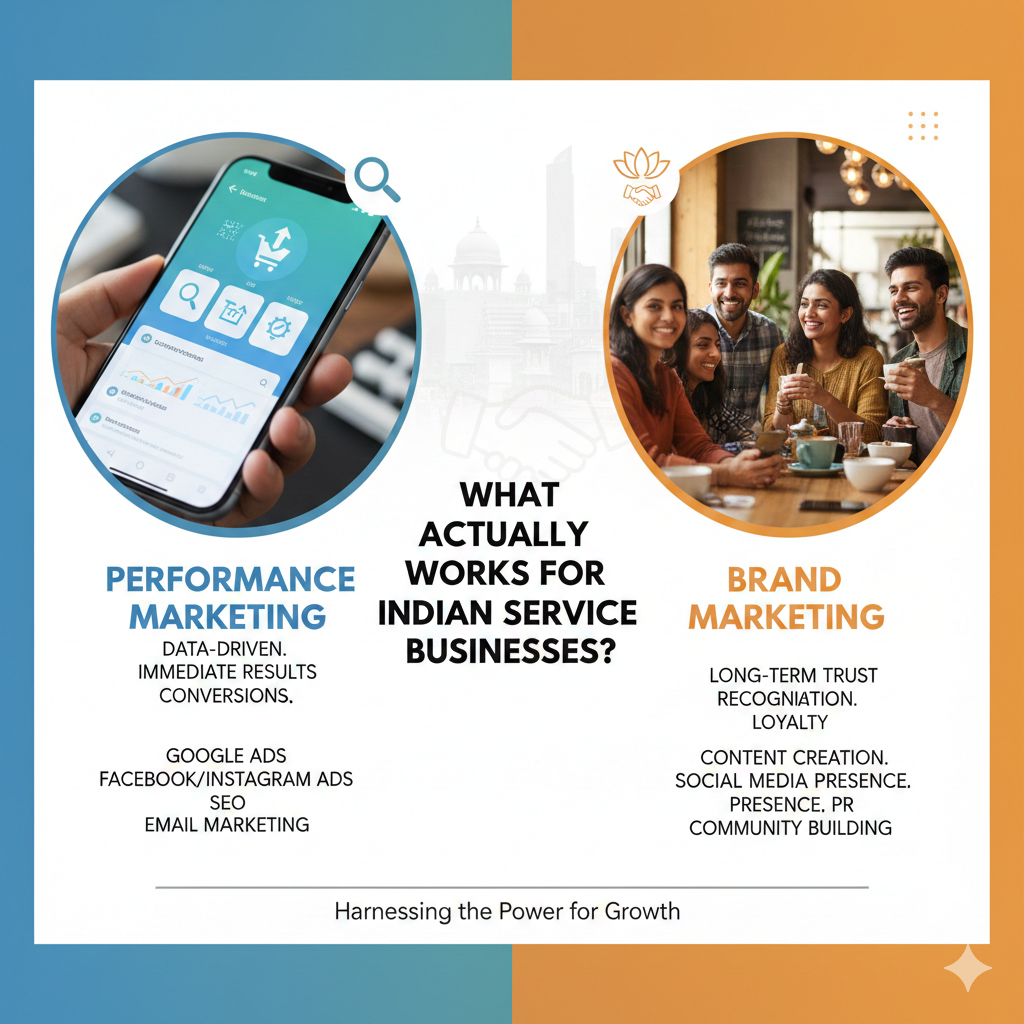
Indian service businesses operate in one of the most competitive and price-sensitive markets in the world. Whether it’s real estate, financial advisory, education, healthcare, IT services, or local professional services, most companies face the same dilemma:
Should we invest in performance marketing for fast leads, or focus on brand marketing for long-term growth?
The answer is not either–or. It depends on business maturity, customer decision cycles, and how trust is built in the Indian market.
This article explains what genuinely works for Indian service businesses today—without theory, jargon, or recycled advice.
Understanding the Buying Reality in Indian Services
Before comparing marketing approaches, it is important to understand how customers in India actually choose service providers.
In most service categories, customers:
- compare multiple providers aggressively
- seek recommendations and online proof
- take time to evaluate credibility
- often speak to sales teams before deciding
Unlike product e-commerce, services depend heavily on confidence, perceived reliability, and reputation.
This changes how both performance and brand marketing perform.
What Performance Marketing Really Delivers for Service Businesses
Performance marketing works best when a clear action can be driven—such as enquiry, booking, or consultation.
For Indian service businesses, its real strengths are:
1. Demand capture, not demand creation
Performance channels primarily capture people who already have intent.
They rarely create interest for a service the customer was not considering.
This makes performance marketing highly effective when:
- customers are already searching
- the category is familiar
- price and availability are key decision factors
2. Faster sales feedback
For service companies that need quick validation of:
- a new location
- a new service offering
- a new pricing model
performance campaigns provide rapid market feedback that traditional branding cannot.
3. Sales team enablement
A well-structured performance setup helps sales teams prioritise:
- geographies
- service types
- high-value enquiries
This operational advantage is often underestimated.
However, performance marketing alone has a clear limitation in India:
It struggles to build preference.
When multiple competitors are running similar campaigns with similar offers, the deciding factor becomes reputation—not targeting or ad optimisation.
What Brand Marketing Actually Achieves in Indian Service Categories
Brand marketing for services in India plays a very different role compared to FMCG or consumer apps.
Its primary job is not recall—it is risk reduction in the customer’s mind.
1. Trust acceleration
Indian consumers are cautious about service quality, post-sale support, and delivery commitments.
Brand visibility creates psychological reassurance that the company is:
- stable
- established
- less risky
This matters strongly in sectors such as:
- real estate
- financial services
- education
- healthcare
- B2B services
2. Sales conversion support
In practice, brand marketing often works behind the scenes.
When prospects:
- search the company name
- visit the website
- check social media
- read reviews
their final decision is influenced by how credible and consistent the brand appears.
This significantly improves close rates for sales teams.
3. Price resistance
Strong brand presence reduces dependency on discounts and promotions.
In Indian markets where price competition is intense, this is a critical long-term advantage.
The Core Difference in Impact
For Indian service businesses, the difference is not about awareness versus leads.
The real difference is:
- Performance marketing generates conversations.
- Brand marketing improves the outcome of those conversations.
When only performance is used, companies often experience:
- high enquiry volume
- low conversion
- inconsistent deal quality
When only brand marketing is used, companies often experience:
- better inbound perception
- weak demand flow
- delayed revenue impact
What Actually Works at Different Business Stages
Early-stage and growing service companies
The most practical approach is performance-first, but not performance-only.
The priority should be:
- validating market demand
- understanding customer profiles
- building a predictable lead engine
At the same time, basic brand foundations must exist:
- clear positioning
- professional creative standards
- consistent messaging
- credible digital presence
Without these, performance campaigns will always struggle to convert efficiently.
Established and multi-location service businesses
At this stage, growth constraints are rarely only about lead volume.
They are usually related to:
- differentiation
- brand familiarity across regions
- long sales cycles
- declining conversion efficiency
Here, brand marketing becomes a growth lever—not a branding exercise.
It supports:
- faster decision-making
- improved referral flow
- higher lifetime value
- stronger regional presence
Performance marketing still runs, but its role shifts towards scale and optimisation rather than pure acquisition.
Why Indian Markets Require a Blended Approach
Indian service buyers rarely move linearly from advertisement to purchase.
A typical journey includes:
- multiple searches
- WhatsApp conversations
- offline discussions
- social proof checks
- local referrals
This fragmented journey means:
- performance marketing introduces or captures the opportunity
- brand marketing reassures and reinforces the choice
Both operate at different psychological moments in the buying process.
The Practical Allocation Model for Service Businesses
Instead of separating budgets into rigid performance and brand silos, Indian service businesses should think in two functional layers:
Layer 1 – Revenue activation
- enquiry generation
- call and lead campaigns
- retargeting
- high-intent search coverage
This is performance-driven.
Layer 2 – Confidence building
- storytelling around experience and outcomes
- leadership or expert positioning
- customer success narratives
- regional presence communication
This is brand-driven.
The effectiveness comes not from equal budget allocation—but from aligned messaging across both layers.
The Biggest Mistake Indian Service Businesses Make
The most common mistake is treating brand marketing as a creative exercise and performance marketing as a technical exercise.
In reality:
Both must be guided by the same positioning, value proposition, and audience understanding.
When branding speaks one language and performance ads speak another, trust breaks—and conversion suffers.