
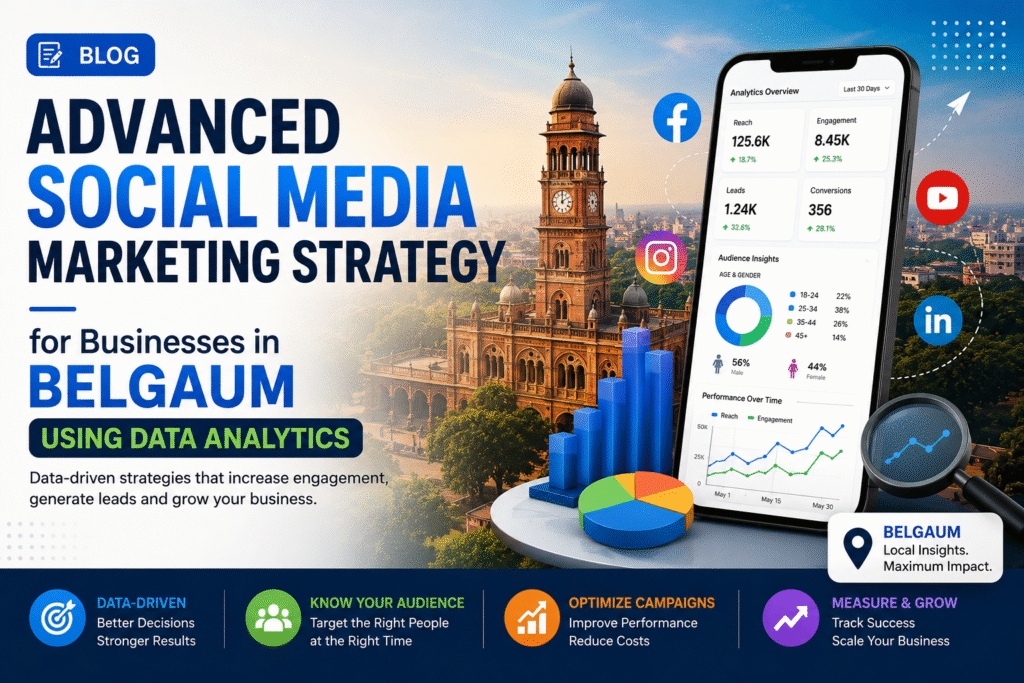
Social media has become one of the most powerful marketing channels for businesses in Belgaum. From local retail stores and restaurants to real estate companies, educational institutes, salons, fitness centers, and service providers, businesses are using platforms such as Instagram, Facebook, YouTube, and LinkedIn to reach potential customers.
However, simply posting content regularly is no longer enough. Modern social media marketing requires a data-driven approach. Businesses need to understand what their audience is watching, clicking, sharing, saving, and purchasing. By using data analytics, businesses in Belgaum can create smarter campaigns, reduce marketing waste, and generate better business results.
This article explains advanced social media marketing strategies that businesses in Belgaum can use with data analytics.
Why Data-Driven Social Media Marketing Matters in Belgaum
Many businesses create social media content based on assumptions. They may post whenever they have time, promote products without understanding customer behavior, or spend money on advertisements without tracking conversions.
Data analytics changes this approach.
Instead of asking, “What should we post today?” businesses can ask:
- Which content generates the most engagement?
- Which audience segment converts the best?
- Which platform brings the highest-quality leads?
- What time are local customers most active?
- Which advertising campaign produces the lowest cost per lead?
- Which content generates actual sales?
For a business operating in Belgaum, this data can help identify customer preferences across different areas, age groups, interests, and purchasing behaviors.
1. Build a Data-Based Social Media Marketing Funnel
An advanced social media strategy should follow the complete customer journey.
The marketing funnel generally includes:
Awareness
The customer discovers your business through videos, reels, advertisements, search, or recommendations.
Consideration
The customer visits your profile, website, or landing page and compares your products or services.
Conversion
The customer sends an inquiry, makes a purchase, books an appointment, or signs up for a service.
Retention
The customer returns, purchases again, leaves a review, or recommends your business.
Businesses in Belgaum should track performance at every stage of this funnel. For example, a digital marketing institute may receive thousands of video views but only a small number of course inquiries. This indicates that the business needs to analyze the consideration and conversion stages, not just focus on increasing views.
2. Use Audience Analytics to Understand Local Customers
Social media platforms provide detailed audience insights.
Businesses can analyze:
- Age groups
- Gender distribution
- Locations
- Interests
- Device usage
- Active hours
- Engagement behavior
For example, a clothing store in Belgaum may discover that its Instagram audience is primarily women aged 18 to 35. A coaching institute may find that students and parents respond differently to advertisements.
This information can help businesses create specific content for different audience segments instead of using the same message for everyone.
A business can create separate campaigns for:
- Students
- Working professionals
- Parents
- Business owners
- Young adults
- Local shoppers
Audience segmentation improves relevance and can significantly improve campaign performance.
3. Analyze Content Performance Beyond Likes
Likes are only one part of social media analytics.
Advanced content analysis should include:
- Reach
- Impressions
- Watch time
- Average retention
- Saves
- Shares
- Comments
- Profile visits
- Link clicks
- Leads
- Sales
For video content, watch time and retention are especially important. If viewers leave within the first three seconds, the opening hook may be weak.
If a particular type of Instagram Reel receives significantly higher saves and shares, the business should analyze what made that content successful.
For example, a business in Belgaum may discover that:
- Educational videos generate saves
- Customer testimonials generate trust
- Product videos generate website clicks
- Offers generate direct inquiries
This data can help create a content strategy based on actual customer behavior.
4. Use A/B Testing for Social Media Campaigns
A/B testing is an advanced technique used to compare two versions of a campaign.
Businesses can test:
- Different headlines
- Images versus videos
- Short versus long copy
- Different calls to action
- Different audience groups
- Different landing pages
For example, a real estate company in Belgaum could test two advertisements:
Ad A: “Book Your 2BHK Flat in Belgaum”
Ad B: “Own Your Dream Home in Belgaum”
If Ad A generates a lower cost per qualified lead, the business can use similar messaging in future campaigns.
Testing eliminates guesswork and helps businesses make decisions based on performance data.
5. Track Conversions, Not Just Engagement
One of the biggest mistakes businesses make is focusing only on likes and followers.
A successful social media campaign should connect marketing activity with business outcomes.
Important conversion metrics include:
- Cost per lead
- Cost per purchase
- Conversion rate
- Return on ad spend
- Customer acquisition cost
- Revenue generated
Businesses should use tracking tools such as website analytics, conversion tracking, UTM parameters, and platform reporting dashboards.
For example, if a business receives 100 leads from social media but only 5 become customers, the business needs to analyze the complete conversion journey.
The problem could be:
- Poor lead quality
- Slow response time
- Weak landing page
- Incorrect audience targeting
- Unclear offer
Data helps identify the real problem.
6. Develop a Localized Content Strategy for Belgaum
Businesses targeting Belgaum should create content that feels relevant to local customers.
Content can include:
- Local events
- Seasonal offers
- Local customer stories
- Area-specific promotions
- Regional festivals
- Customer testimonials
- Behind-the-scenes business content
Using location-specific messaging can improve engagement and brand recognition.
Businesses can also create content targeting nearby areas and communities when relevant. However, location targeting should always be natural and relevant to the actual service area.
A local audience is more likely to engage with content that reflects its environment, culture, and daily experiences.
7. Use Social Listening to Understand Customer Sentiment
Social listening involves monitoring online conversations related to your brand, products, services, and competitors.
Businesses can analyze:
- Customer complaints
- Common questions
- Product preferences
- Competitor feedback
- Industry trends
For example, if many customers are asking about pricing, delivery, availability, or course duration, these questions can become future social media content.
Social listening allows businesses to understand what customers are actually discussing instead of relying only on surveys or assumptions.
8. Create a Performance Dashboard
A professional social media marketing strategy should have a clear reporting system.
A monthly dashboard can track:
| Metric | Purpose |
|---|---|
| Reach | Measures audience exposure |
| Engagement Rate | Measures content interaction |
| Video Watch Time | Measures audience attention |
| Click-Through Rate | Measures interest |
| Cost Per Lead | Measures advertising efficiency |
| Conversion Rate | Measures business performance |
| ROAS | Measures advertising profitability |
Businesses can use this information to compare monthly performance and identify trends.
For example, a campaign may have a high click-through rate but a low conversion rate. This could indicate a problem with the landing page or offer.
9. Use Data to Improve Paid Advertising
Paid social media advertising becomes more powerful when campaigns are continuously optimized.
Businesses in Belgaum can analyze:
- Audience performance
- Placement performance
- Creative performance
- Budget distribution
- Frequency
- Conversion data
If one audience generates leads at ₹100 each while another generates leads at ₹300 each, the budget can be adjusted accordingly.
Similarly, advertisements with low engagement can be replaced with new creative variations.
The goal is not simply to spend more money. The goal is to spend the budget more efficiently.
10. Combine AI and Data Analytics for Smarter Marketing
Artificial intelligence is increasingly becoming part of modern social media marketing.
Businesses can use AI tools to:
- Analyze customer sentiment
- Generate content ideas
- Identify trends
- Create audience segments
- Predict campaign performance
- Automate reporting
However, AI should support strategy rather than replace human understanding.
The best results come from combining analytics, creativity, local market knowledge, and customer insights.
Conclusion
Advanced social media marketing in Belgaum requires more than regular posting and increasing follower counts. Businesses need to understand data and use it to make better marketing decisions.
By analyzing audience behavior, tracking content performance, testing campaigns, measuring conversions, using local content, monitoring customer sentiment, and optimizing advertising budgets, businesses can build a more effective digital marketing system.
Data analytics allows businesses to understand what works, what does not work, and where improvements are needed.
Whether you operate a retail store, educational institute, restaurant, real estate business, fitness center, or service company, a data-driven social media strategy can help you reach the right customers, improve engagement, generate better leads, and increase business growth.
For businesses in Belgaum, the future of social media marketing is not just about being active online. It is about using data to make every marketing decision smarter.