
In today’s competitive online world, businesses no longer wait for customers to walk into their stores. Instead, they actively use digital marketing to attract potential customers online. This process is called lead generation.
Whether you run a business, work in marketing, or are planning to build a career in digital marketing, understanding the lead generation process is essential. In this blog, we’ll explain the complete lead generation process step by step with real examples so beginners can easily understand how it works.
What Is Lead Generation?
Lead generation is the process of attracting people who are interested in your product or service and converting them into potential customers, also called “leads.”
A lead can be:
- Someone filling out a contact form
- A person downloading a free ebook
- A student registering for a demo class
- A customer requesting a quote
In simple words, lead generation helps businesses find people who may buy from them in the future.
Why Is Lead Generation Important?
Without leads, businesses struggle to get customers. Lead generation helps companies:
- Increase sales
- Build customer relationships
- Grow brand awareness
- Improve marketing ROI
- Generate consistent business opportunities
Today, almost every industry uses online lead generation, including:
- Educational institutes
- Real estate companies
- Hospitals
- E-commerce brands
- Digital marketing agencies
- Software companies
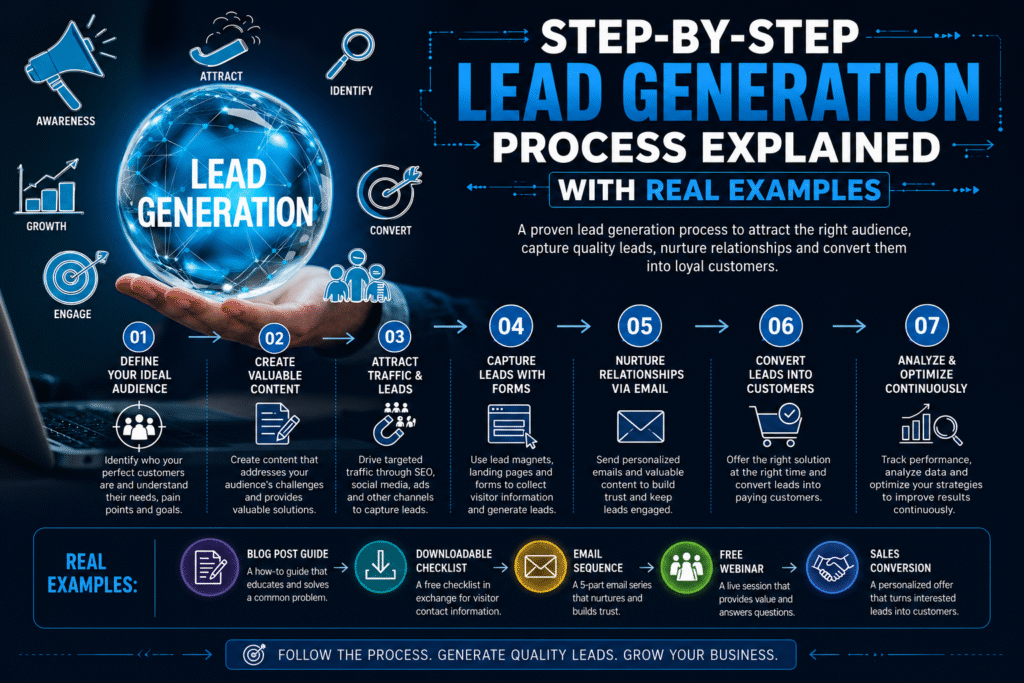
Step-by-Step Lead Generation Process
Let’s understand the complete process in detail.
Step 1: Identify Your Target Audience
Before generating leads, businesses must know who their ideal customers are.
Questions to Ask:
- Who needs your product or service?
- What problems do they face?
- What age group are they in?
- Where do they spend time online?
Real Example:
A digital marketing institute in Belgaum wants more admissions. Their target audience may include:
- College students
- Job seekers
- Small business owners
- Freelancers
Knowing the audience helps create better marketing campaigns.
Step 2: Create a Valuable Offer
People don’t share their contact details without a reason. Businesses must offer something valuable in exchange.
This is called a lead magnet.
Popular Lead Magnets:
- Free webinar
- Ebook
- Free consultation
- Demo class
- Discount coupon
- Free audit report
Real Example:
A digital marketing institute offers:
“Attend a FREE Digital Marketing Demo Class”
Interested students register by entering their name, phone number, and email address.
Now the institute has generated leads.
Step 3: Drive Traffic to Your Website or Landing Page
Once the offer is ready, businesses need to bring people to their website or landing page.
Common Traffic Sources:
- SEO (Search Engine Optimization)
- Google Ads
- Facebook & Instagram Ads
- YouTube Marketing
- Email Marketing
- Social Media Posts
Real Example:
A business runs Google Ads targeting:
“Best Digital Marketing Course in Belgaum”
When users click the ad, they land on a page with course details and a registration form.
Step 4: Capture Lead Information
This is where visitors become leads.
Businesses use:
- Contact forms
- Chatbots
- Popups
- Landing pages
- Registration forms
Information Usually Collected:
- Name
- Email address
- Phone number
- Business details
Real Example:
A student visits a landing page and fills:
- Name: Rahul
- Email: rahul@gmail.com
- Phone: 9876543210
Now Rahul becomes a lead.
Step 5: Qualify the Leads
Not every lead becomes a customer. Businesses need to identify which leads are genuinely interested.
This process is called lead qualification.
Qualified Leads Usually:
- Show interest
- Have a budget
- Need the service
- Are ready to take action
Real Example:
Two students register for a course:
- Student A wants to join next week
- Student B is only browsing
Student A is considered a high-quality lead.
Step 6: Nurture the Leads
Many leads don’t buy immediately. Businesses must build trust through follow-ups.
This process is called lead nurturing.
Lead Nurturing Methods:
- Email campaigns
- WhatsApp follow-ups
- Phone calls
- Educational content
- Testimonials
- Free workshops
Real Example:
After a student registers for a demo class, the institute sends:
- Course details
- Student success stories
- Placement information
- Free learning resources
This increases the chances of conversion.
Step 7: Convert Leads into Customers
Once trust is built, businesses encourage leads to take action.
Conversion Actions:
- Purchase a product
- Enroll in a course
- Book a consultation
- Subscribe to a service
Real Example:
After attending the demo class, Rahul enrolls in the digital marketing course.
The lead is now converted into a customer.
Step 8: Analyze and Improve the Process
Successful businesses continuously track their lead generation performance.
Important Metrics:
- Website traffic
- Conversion rate
- Cost per lead
- Lead quality
- Return on investment (ROI)
Real Example:
If Facebook Ads generate cheaper and better leads than Google Ads, the business may increase its Facebook advertising budget.
Best Channels for Online Lead Generation
Here are the most effective lead generation platforms in 2026:
1. Google Search
Great for targeting people actively searching for services.
Example:
“Digital Marketing Course Near Me”
2. Facebook & Instagram Ads
Excellent for reaching younger audiences.
Example:
Running video ads promoting free workshops.
3. YouTube Marketing
Educational videos attract highly interested leads.
Example:
“Top 5 Digital Marketing Skills to Learn in 2026”
4. SEO (Search Engine Optimization)
SEO helps websites rank on Google organically.
Example:
Blogs like:
- “Best Digital Marketing Course in Belgaum”
- “Career Opportunities in Digital Marketing”
5. Email Marketing
Useful for nurturing and converting leads.
Example:
Sending weekly learning tips to students.
Common Mistakes in Lead Generation
Many businesses fail because of these common mistakes:
1. Targeting the Wrong Audience
Even great ads fail if shown to the wrong people.
2. Weak Landing Pages
Confusing pages reduce conversions.
3. No Follow-Up
Many leads are lost because businesses never contact them again.
4. Ignoring Mobile Users
Most users browse on smartphones today.
5. Not Tracking Results
Without analytics, businesses cannot improve campaigns.
Future of Lead Generation
Lead generation is becoming more advanced with:
- Artificial Intelligence (AI)
- Automation tools
- Chatbots
- Personalized marketing
- Predictive analytics
Businesses that master digital lead generation will grow faster in the coming years.
Final Thoughts
Lead generation is one of the most important skills in digital marketing. It helps businesses attract the right audience, build trust, and increase sales.
To summarize, the lead generation process includes:
- Identifying the target audience
- Creating valuable offers
- Driving traffic
- Capturing lead details
- Qualifying leads
- Nurturing leads
- Converting customers
- Analyzing performance
Whether you are a student, entrepreneur, or marketer, learning lead generation can open exciting career and business opportunities.
If you want to build practical digital marketing skills, start learning how real businesses generate and convert leads online